















With a clear vocation towards the world of technology, particularly in video and audio management & processing systems for security and Law Enforcement, Blasco has developed his entire professional career at ISID. In his current role as Chief Technology Officer, his main responsibility is to ensure the integration of different technologies, including artificial intelligence (AI), that allow the extraction of information from various data sources, with the aim of enabling its analysis and management in a simple and quick manner.
The impact of AI is tremendous… does this also apply to the security sector?
As has happened in other aspects of our lives, artificial intelligence has burst onto the security scene. In the past, when an incident occurred, law enforcement officers or private security agents had to take a video tape from one or two cameras (the only ones available in the area) and view it in real time or at high speed. A lot of time had to be invested to analyze it and investigate what happened.
AI enables the processing of thousands of videos, analyzing them, filtering them, and turning the information they contain into actionable insights
This has changed radically. There are no longer just one or two cameras, but hundreds. And for a human being it would be impossible to watch all that content. This is where technologies like artificial intelligence come into play, offering the capability to manage such a vast amount of information through platforms like Intelion.
In our case, AI is the tool that allows us to process those thousands of videos, analyze them, filter them, and convert the information they contain into something usable.
Is this what makes the concept of a Safe City a reality?
Indeed. Now the requirements from the organizations we work with are greater. They demand a high capacity for processing, analyzing, managing, and storing audio and video, often in real-time.
With the number of sources (cameras) in a big city, we are talking about enormous amounts of data. To manage them appropriately, amongst other things, we rely on edge architecture. Typically, all the cameras installed in a specific location connect to a central system (a VMS) and send video 24/7. But for many hours in a row, nothing happens, and would be a waste of time to be sending data, consuming bandwidth, and processing power from the central system.
Therefore, our approach is that at each capture point, at each camera, the information is intelligently filtered and only sent when an event occurs; for example, when movement is detected. This filtering significantly reduces the amount of data sent to the VMS —and to our system— and, consequently, lowers the use of resources, leading to savings.
Although the system itself has all the AI analytics, edge devices include simplified AI models capable of finding one or two faces, certain license plates, etc.
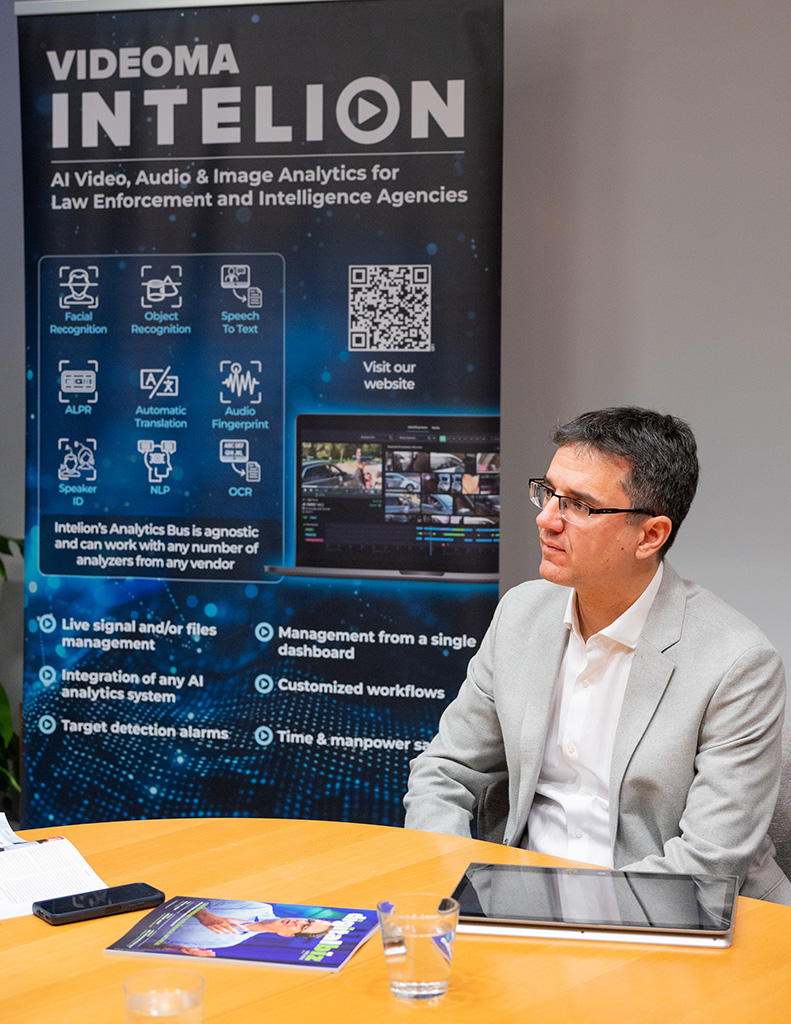
Facial and voice recognition have made giant strides in the last two years, gaining precision. They are now capable of generating positive identifications in complex contexts, with low light situations, profile faces, or those covered with hats or glasses…
The evolution is particularly noticeable in the number of faces that can be identified and compared. AI can extract the imprint of our face or voice and compare it —in immense quantities— with that of other people in very little time. This ability to manage a vast volume of information and extract patterns or traces of situations, people, or entities has been truly disruptive.
What about privacy?
Security agencies in Europe are probably the ones applying privacy law and the new AI directive with the greatest scrutiny, and we must consider that this legislation is not comparable to what may exist in other geographical regions.
In terms of how this affects our platform, it translates into the need for small adjustments. For example, the new law requires that if we detect a vehicle that is being investigated, all contextual information must be removed, and everything around it eliminated. The environment can no longer be shown. Also, facial analysis must be done by similarity in many cases, without individual biometrics.
Intelion allows the integration of different information «islands» to get context to investigate a specific aspect
In general, the new law has forced us to make small changes to our platform to adapt it to the new legal scenario in which police or intelligence agencies must operate. Of course, there are always situations where a judicial order can expand the possibilities for investigations in specific cases, but at all times we comply with current law and rules. No biometric information is transmitted if it is not allowed, personal data of third parties is not stored, etc.
Obviously, in other countries or continents, the scenario is much more open. There is facial biometrics in the streets, total tracking… But in Europe, which is our primary market, we have been adapting to how to use AI technology within the law, strictly complying with regulations.
Are we really moving towards that scenario of a safe city?
Yes. Actually, cities have no choice. With the increasing number of inhabitants moving from rural areas in almost every country, the only way to maintain security at acceptable levels is to employ automated means.
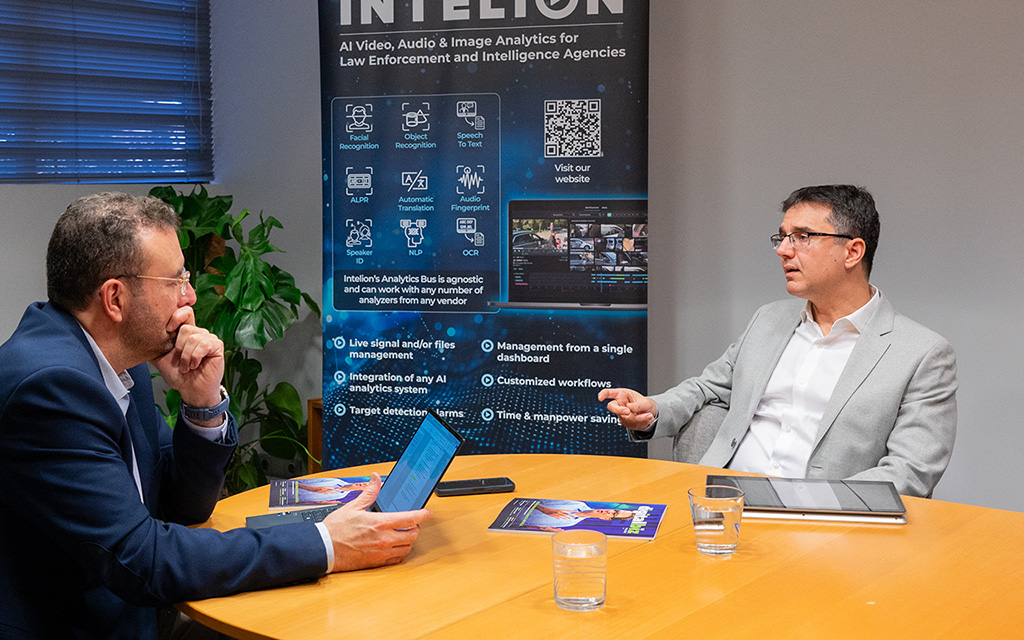
These technologies, including AI, greatly assist security agencies, which are the primary users of our platform, drastically reducing repetitive and manual activities. Having a person watch a recording does not add value. However, incorporating AI into that process allows for the automation of detection and filtering of information, freeing that person for more valuable activities.
For example, to deter uncivic behavior, AI could help detect when a citizen leaves a trash bag outside the bin. It makes no sense for a police officer to be reviewing hours of video for this. The efficient approach is for the camera to detect these behaviors and alert the officer when the infraction occurs.
At each capture point, at each camera, the information is filtered and only sent when an event happens
These technologies will significantly facilitate the surveillance already practiced manually, as well as the analysis and detection of patterns. The use of this information will later depend on the needs of each agency.
The goal of AI is precisely to take care of that mechanical work, extracting the necessary information about a specific source. Security agents will be able to dedicate their efforts to other tasks more related to prevention or protection, always aiming to move towards safer cities.
What possibilities does your platform offer?
Our platform is primarily used by state security agencies and Law Enforcement. In fact, over the past five years, we have developed it in collaboration with them to achieve a solution that perfectly fits their needs.
The result is Intelion, a platform that allows the integration of different information sources to get context for a specific aspect to investigate. For example, if license plate detection cameras are integrated with a database of vehicles wanted for any reason, during an international conference in a city like Madrid, it is possible to know if one of those suspicious vehicles is entering the city, compare the license plates with that database, and notify if they are accessing a specific area.
Furthermore, if an incident has already occurred, it facilitates the forensic analysis of the situation, collecting data about what happened (from all types of sources and devices) and understanding how it occurred, who was involved, etc.
Finally, another functionality that has been recently incorporated is the ability to extract patterns of vehicle clustering, which allows for understanding the historical relationships that, for example, a specific vehicle has had. It is possible to know if it typically travels with other vehicles along the same route, which would indicate a relationship between them. All of this is done using the traffic cameras located throughout the city. This is very useful in areas such as border control or organized crime investigations.
The goal is to collect and integrate a large amount of information from different sources, making it accessible to security agencies and focusing on the tasks that need to be resolved. All of this is done in a simple and efficient manner.
Is it an easy platform to use?
The underlying technology is obviously complex, as it involves AI, but operating it is not. Whenever we start a project, the first thing we do is thoroughly understand the real needs of the client/agency in question and look for the best way solve their problems. For this, there is a learning and training phase alongside the client to adapt the platform to their needs. After it is delivered, the platform is fully autonomous, automatable, and easy to use for the end user.

Our two guiding principles are simplicity and efficiency. We adapt both the interface and the necessary automations. Additionally, we streamline hardware usage: we implement intelligent processes capable of deciding what needs to be analyzed, when, and with which technology, in order to use the least amount of resources possible.
To achieve this, we use a cascading analysis system. For example, the license plate detection does not activate unless a vehicle is detected in the image; and a vehicle is not searched for if there hasn’t been any movement in the video. This minimizes the usage (and thus the cost) of the analyzers that require the majority of the system’s hardware power, hence reducing electricity consumption and the environmental impact.
Does this mean economic savings?
Absolutely. It is a savings at different levels. The most important aspect is that it enables the management of a large number of cameras —or media files—. Typically, our clients have already invested in infrastructure and devices. The information already exists, and our platform makes it feasible to process it.
We are agnostic at all levels; we are not tied to any specific technology or adoption model
Furthermore, it is an especially efficient solution, both in terms of resource consumption and the time or effort that personnel must invest to achieve results, contributing to a safer city and better quality of service.
The goal is to optimize the work of security and law enforcement areas, which often spend time on repetitive tasks instead of using those resources much more efficiently.
Are you tied to any particular technology?
No. We are agnostic at all levels. This means that we are not tied to any specific technology or adoption model, and we adapt to the client’s preferences, for example, regarding deployment: cloud, on-premise (at the client’s site), or hybrid. We are also agnostic in the analysis technologies: while we have our own, we integrate with any third-party solution, allowing the platform to evolve continuously with the current state of technology.
 That is something very important in our sector [of AI]. There are providers that do a particular analysis very well, but every so often something disruptive emerges that makes it obsolete.
For example, at one time there were companies specialized in text analysis, but with the arrival of LLMs, those technologies have been relegated. They are no longer useful. In such cases, or if the client prefers to switch to a different brand of analyzer, we can change the module for another or for the next generation, and the platform would still remain the same. It is a living platform that updates itself as technologies advance.
Are there other applications for these technologies?
Yes, of course. To give you a bit of history, our company was born to serve the broadcast and video world (production companies, television networks, etc.) and to manage the archiving of this content, the systems for searching and retrieving sequences, media monitoring, brand tracking, etc.
We have also developed projects in other fields. For example, in the healthcare sector, it is being applied to record surgeries with the aim of documenting them for teaching and other medical uses. And for preventive medicine, analyzing diagnostic imaging tests to detect diseases. It is true that there is still a long way to go in this area, but we are already applying AI techniques in ongoing projects.
AI is allowing purely mechanical or repetitive tasks to be assisted —not replaced— by automated processes
Then there is our Probus platform, which is offered as a cloud service aimed at the legal profession. It is a personal assistant that helps lawyers locate information by analyzing hours of audio and video from court hearings. The result is a transcription that allows searches by speakers, keywords, etc. Thus, these technologies can be applied across multiple sectors. And there are many yet to be discovered.
What does the future hold for us?
We have all seen Terminator, but we also have the future envisioned by Isaac Asimov. I cannot speak to what is to come, because every six months there is a new disruption, and we do not know what the next one will be. What is evident is the current application of AI: it is allowing a large number of purely mechanical or repetitive tasks to be assisted —not replaced— by automated processes.
I hope we do not lose ourselves in technology, that we can distinguish what is intrinsically human, what makes us special, and enhance it.